Component Types
Components are the building blocks of an Agentic Flow. They are organised into categories in the sidebar. Each component exposes input and output handles that determine how data flows between them.
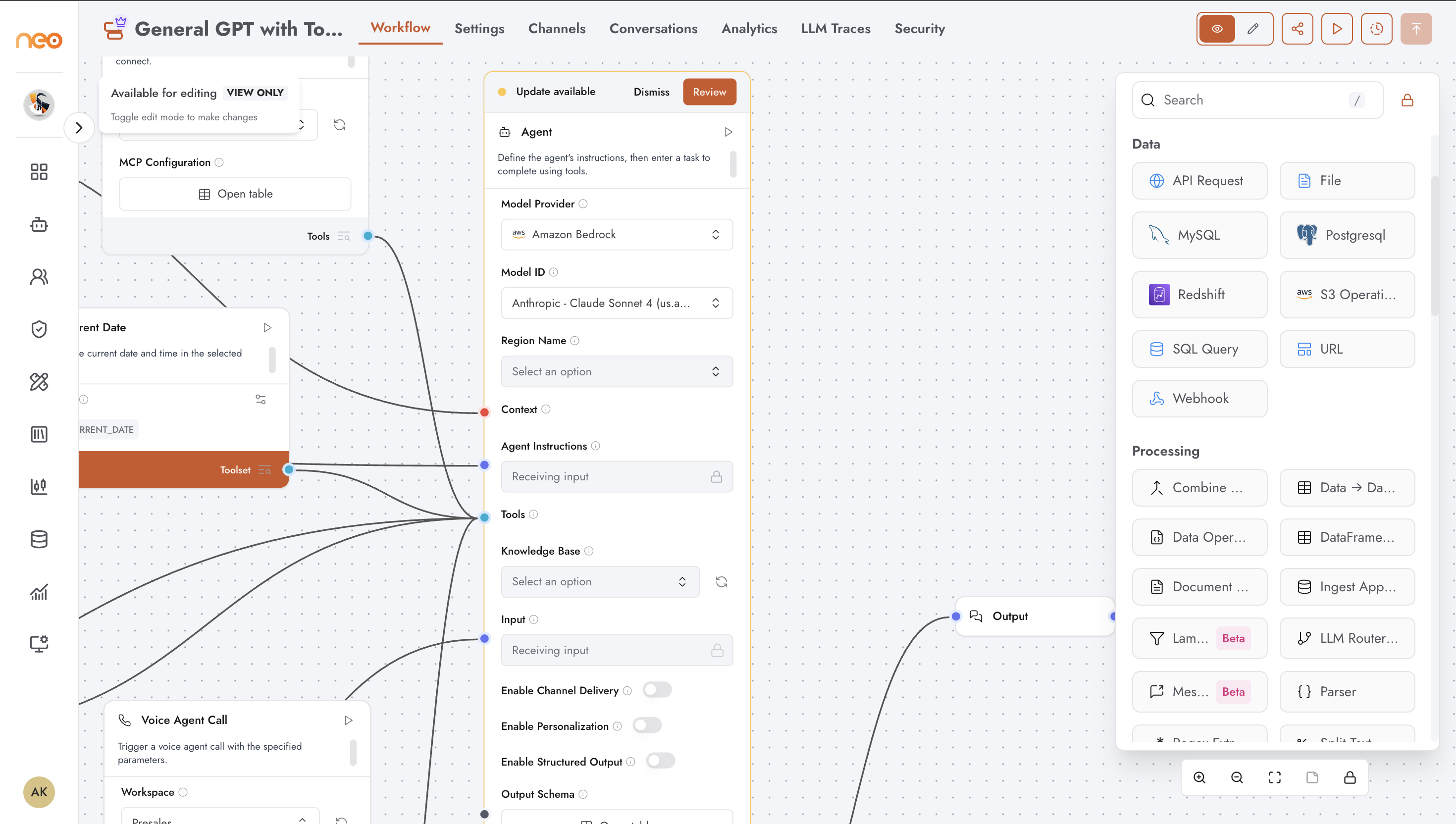
Saved
The Saved category lists components you have previously saved from the canvas for reuse across flows. Right-click any component on the canvas and select Save to add it here.
Input / Output
Component |
Description |
|---|---|
The entry point for the flow. Receives the user’s message or trigger payload and passes it downstream. |
|
The exit point of the flow. Returns the final result to the caller or connected channel. |
The Playground is only available when the flow contains at least one Input and one Output component.
Prompts
Component |
Description |
|---|---|
Constructs a prompt string from a template. Supports variable interpolation using |
Data
Component |
Description |
|---|---|
Makes an HTTP request to an external URL and passes the response downstream. |
|
Loads a file (uploaded or from a URL) and makes its content available to the flow. |
|
Executes a query against a MySQL database and returns the results. |
|
Executes a query against a PostgreSQL database and returns the results. |
|
Executes a query against an Amazon Redshift data warehouse. |
|
Reads from or writes to an Amazon S3 bucket. |
|
Executes a SQL query against a configured database connection. |
|
Fetches content from a URL and returns the raw response. |
|
Receives an inbound HTTP request and uses the payload as input to the flow. |
Processing
Component |
Description |
|---|---|
Merges outputs from multiple upstream components into a single data object. |
|
Converts raw data into a tabular DataFrame structure for further processing. |
|
Applies transformations to structured data (filter, map, merge, rename, remove keys, etc.). |
|
Applies operations on a DataFrame (sort, filter, sample, select columns). |
|
Extracts text and structure from documents (PDF, DOCX, etc.) using configurable parsing strategies. |
|
Captures the approved response from a Human In The Loop step and injects it back into the flow. |
|
Lambda Filter (Beta) |
Filters a list of items using a custom expression. |
Routes the flow to one of several downstream paths based on the output of an LLM classification. |
|
Message to Data (Beta) |
Converts a conversation message object into a structured data record. |
Parses structured text (JSON, XML, CSV) into a usable data object. |
|
Extracts values from text using a regular expression pattern. |
|
Splits text or a DataFrame into chunks using configurable size and overlap settings. |
|
Converts a streaming data response into a standard message format. |
Knowledge Base
Component |
Description |
|---|---|
Retrieves relevant chunks from a knowledge base using semantic search. Connects to knowledge bases configured in the Foundry. |
|
Queries an Amazon OpenSearch index directly with configurable search type, scoring threshold, and hybrid search support. |
Agents
Component |
Description |
|---|---|
A general-purpose autonomous agent that uses an LLM with tools and knowledge bases to reason and act over multiple steps. |
|
Intent Classification Agent (Beta) |
Classifies the user’s intent and returns a structured output with the classified category. |
Human In The Loop (Beta) |
Pauses the flow and sends an approval request to configured delivery targets. Resumes once approved or rejected. |
Channel Agent (Legacy) |
An agent wired to a communication channel. Handles inbound messages and routes outbound replies to configured delivery targets. Superseded by the Channel Output node — use Channel Output for all new channel integrations. See Channels. |
Calls another Agentic Flow as a sub-flow and returns its output into the current flow. |
|
Triggers a Voice Agent call and returns the call response. |
|
Immediately terminates the current flow execution with an optional break reason and instruction. |
Logic
Component |
Description |
|---|---|
Branches the flow based on a boolean condition evaluated against an input value. |
|
Condition (Legacy) |
Evaluates a conditional expression and routes to one of multiple output paths based on the result. |
Executes a Python snippet and returns the result. Use for custom logic that cannot be expressed with other components. |
|
Applies a configured guardrail policy to data passing through this point. Blocks or flags content that violates the policy. |
|
Iterates over a list of items and executes a downstream path for each item. |
|
Run Flow (Beta) |
Executes another flow by ID and returns its output. |
Evaluates a confidence score and branches on whether it exceeds a configured threshold. |
Others
Component |
Description |
|---|---|
A non-executable annotation node. Add comments or labels to sections of the canvas. |
|
Outputs the current date and time, which can be injected into prompts or conditions. |
|
Retrieves the conversation message history for use in prompts or as context for an agent. |
|
Parses agent output into a structured schema (JSON object) according to a defined format. |
Integrations
The Integrations category combines built-in tools, MCP tool components, and any custom tools configured in the workspace. The category is always visible; the components inside depend on what has been set up by a workspace administrator.
Component |
Description |
|---|---|
Calculator |
Evaluates a mathematical expression and returns the result. |
Python REPL |
Executes Python code in a sandboxed environment and returns the output. |
Connects to an MCP (Model Context Protocol) server configured in the workspace and exposes its tools to an Agent component. |
|
Connects to any publicly accessible MCP server by URL. |
|
Custom Tools |
In-house and custom tools added by a workspace administrator. Each appears as a draggable component once configured. |
Bundles
Bundles are grouped sets of components from a specific vendor or framework. They appear as collapsible sections at the bottom of the sidebar.
Agentic Patterns
Advanced multi-agent orchestration components for structured collaboration and task decomposition.
Component |
Description |
|---|---|
Defines a capability that can be assigned to an agent within a multi-agent pattern. |
|
Orchestrates multiple agents working in parallel or sequence to complete a shared goal. |
|
Decomposes a goal into a hierarchical task tree and assigns sub-tasks to agents. |
|
Breaks down a high-level task into smaller sub-tasks for downstream agents. |
|
Coordinates execution of a task graph produced by a decomposer. |
|
Renders a task graph for inspection and monitoring within the flow. |
Memories
Component |
Description |
|---|---|
Stores and retrieves conversation history from a PostgreSQL database for persistent memory across sessions. |
Amazon / AWS
Component |
Description |
|---|---|
Generates text embeddings using Amazon Bedrock embedding models. |
|
Amazon Bedrock Model |
Calls an Amazon Bedrock language model and returns the response. |
Extracts structured data from documents using Amazon Bedrock Data Automation. |
|
Executes code using the AWS AgentCore managed code interpreter service. |
|
Stores and retrieves long-term memory using the AWS AgentCore Memory service. |
|
Generates images using Amazon Nova via Amazon Bedrock. |
|
Generates images using Stability AI models via Amazon Bedrock. |
|
Uploads files to a specified Amazon S3 bucket. |
LangChain
Component |
Description |
|---|---|
Splits text into chunks using a character-based splitter. |
|
A LangChain agent that can read and query CSV files using natural language. |
|
A LangChain agent that can query a SQL database using natural language. |
|
Connects to a SQL database and exposes it as a data source for LangChain agents. |
|
A LangChain agent that uses tool-calling capable language models to reason and act. |
|
XML Agent (Beta) |
A LangChain agent that processes XML-structured inputs and tool responses. |
MCP
Component |
Description |
|---|---|
Connects to an MCP (Model Context Protocol) server configured in the workspace and exposes its tools to an Agent component. |
|
Connects to any publicly accessible MCP server by URL. |
Red Hat
Component |
Description |
|---|---|
Calls a Red Hat–hosted OpenAI-compatible chat endpoint and returns the response. |